
Paul Rickard is CEO of Pocket Living, a leading SME developer of affordable homes for sale and rent. He has 25 years’ experience in real estate having started his career at Andersen, working in real estate and banking capital markets, before joining a corporate finance advisory firm, with a focus on funding, investment, capital markets, treasury and financial planning. Paul has held executive leadership roles in a number of real estate companies and is also Chair of Qualis Flow, a Series A ESG company decarbonising and digitising construction in the UK and US.
Help to Buy is not the only answer
Since Help to Buy closed in 2023, the debate about how to help first-time buyers has circled almost exclusively around whether to bring it back. That is understandable. It was the most effective demand-side intervention this country has run in living memory. It put hundreds of thousands of people into homes who would not otherwise have got there, and it gave smaller developers the confidence to commit capital to schemes they would otherwise have shelved. And, almost uniquely for a housing intervention, it made the Treasury money. The equity stake appreciated with the home and was repaid on sale, turning a subsidy into a return. Name another housing policy in the last twenty years that has done the same. If you were going to obsess over one lever, Help to Buy would be a reasonable choice.
But the narrowness of the conversation has become a problem in itself. Every question about first-time buyers seems to come back to the same place. Do we reintroduce it or do we not. That framing has crowded out a richer discussion about what else might work, and about what combination of measures the sector actually needs.
The case for thinking more broadly is visible in our own numbers at Pocket Living. The average home on one of our schemes is worth roughly what it was in 2021. The average buyer moving into that home earns around twenty percent more than they did four years ago. The average deposit has doubled. One in three buyers at our most recent development paid fully in cash. These are not the numbers of a market that is functioning. They are the numbers of a market where the people who can buy are drawn from an ever smaller pool, increasingly made up of those with access to family wealth or existing capital. The IFS argued this month that Help to Buy mainly benefited higher earners. Our data since closure suggests scrapping it helped them more.
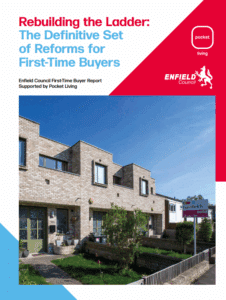
Earlier this year Pocket Living worked with Enfield Council to produce the Rebuilding the Ladder report, handed to the Secretary of State and endorsed by a broad coalition of housebuilders, trade bodies and local authorities. The report sets out 13 practical proposals to support first-time buyers. A properly designed equity loan, part funded by developer contribution rather than sitting entirely on the taxpayer. A version of Freedom to Buy that actually works on new build flats, rather than one that was inadvertently designed in a way that meant no major lender would touch it. Modernised rules around Discount Market Sale, which remains the most underused tenure in the affordable housing family. A student loan linked intermediate tenure that turns an uncertain debt into a real asset. Stamp duty used as a tape rather than a permanent friction at the point of purchase. None of these is a silver bullet. None of them competes with a return of Help to Buy. But they are affective and they are deliverable.
It helps to think of housing delivery as a machine with two ends. The front end is supply, everything that gets a home built, from planning policy to bricks in the ground. The back end is demand, everything that gets that home bought, from the mortgage product to the deposit in the buyer’s account. Over the last two years the government has worked harder on the front end of this machine than any administration in living memory. All of it pointed at the same thing, getting more homes into the machine. The back end, who is actually buying them when they come out, has been left almost entirely alone. You can fix every planning application in London but if the buyer cannot complete, nothing comes out.
That is the argument for a wider debate. Help to Buy was a lever, not the lever, and there is no reason the conversation about its successor has to wait for a political moment that may never come. The levers set out in Rebuilding the Ladder can be pulled in parallel, and several of them can be pulled now.
The goal is not to pick one intervention and wait for it to do all the work. It is to give first-time buyers, and the developers building for them, a back end of the machine that actually functions. That is how you build 1.5 million homes.